Start your giving journey
Find the most effective way for you to give – as an individual, family, organisation or business – so you can focus on making an impact.

Learn and grow
Discover our collection of resources and tools to get you started, extend your giving, or support others on their giving journey.

Double giving by 2030
Our Blueprint to Grow Structured Giving outlines how the philanthropic, for-purpose, business and government sectors can work together to double structured giving from $2.5 billion in 2020 to $5 billion by 2030.

News and stories
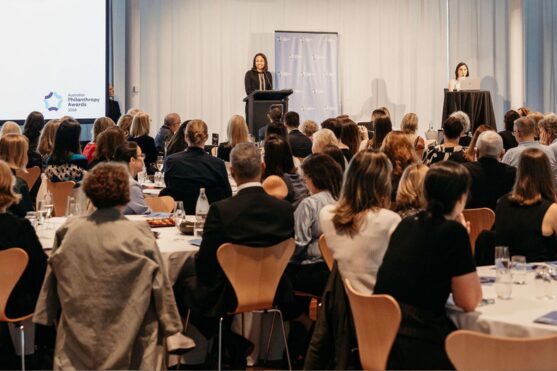
A night celebrating philanthropy
 Sophie Marcard – Director, Marketing and Communications, Philanthropy Australia
 Fri, 19 April 2024
The 2024 Australian Philanthropy Awards ceremony was held on Tuesday 16 April at the Art Gallery of NSW. More than 200 people packed Meers Hall to hear a showcase of the finalists across 9 categories and a surprise 10 Award recipients.
 Read more
Hopes for a breakthrough in childhood diseases underpinned by 10-year funding relationship
Dee Rudebeck, News and Storytelling Advisor
Fri, 19 April 2024
An enduring relationship that has formed between the Stafford Fox Medical Research Foundation (SFMRF) and Murdoch Children’s Research Institute (MCRI) over a decade has been attributed to enabling the latter to develop world-first research into stem cell medicine that could result in treatments for rare or currently incurable and devastating childhood diseases, including heart disease and brain cancer.

Australian Philanthropy Awards 2024 – in pictures
Philanthropy Australia
Fri, 19 April 2024
Take a look at some of the highlights and key moments from the Australian Philanthropy Awards Showcase event including guests, award recipients, finalists, presenters and more.
Impressive leaders recognised with Australian Philanthropy Awards
Tue, 16 April 2024
The award recipients in the 2024 Australian Philanthropy Awards have been announced today, recognising and celebrating extraordinary achievements in contemporary philanthropy.

Stories of giving
Stories to inspire more and better philanthropy. Read about the experiences and motivations of the donors and the causes they are supporting.
Read our stories of givingPhilanthropy Australia National Conference 2022
 Tue, 6 Sep 2022
 Sydney, NSW
Our 2022 national conference For the Love of Humanity – People, Place and Planet was a feast of ideas, insights and inspiration held over 3 days.
Read moreEvents

In conversation with Tirana Hassan and Joseph Skrzynski AO: The intersection of Philanthropy and Human Rights
 Melbourne,VIC
 9:30 am – 11:00 am AEST
Don’t miss this opportunity to join us for a thought-provoking conversation on the intersection of philanthropy and human rights featuring Tirana Hassan and Joseph Skrzynski AO, renowned global leaders in the field.
Read more


Subscribe to Philanthropy Weekly
Please complete your details here to subscribe to Philanthropy Australia’s weekly e-bulletin.
* required fields