
Building future foundations for First Nations philanthropy
 By Krystian Seibert, Executive Director for Policy and Sector Development
 Thu, 28 May 2026
Estimated reading times: 5 minutes
Thu, 28 May 2026
Estimated reading times: 5 minutes

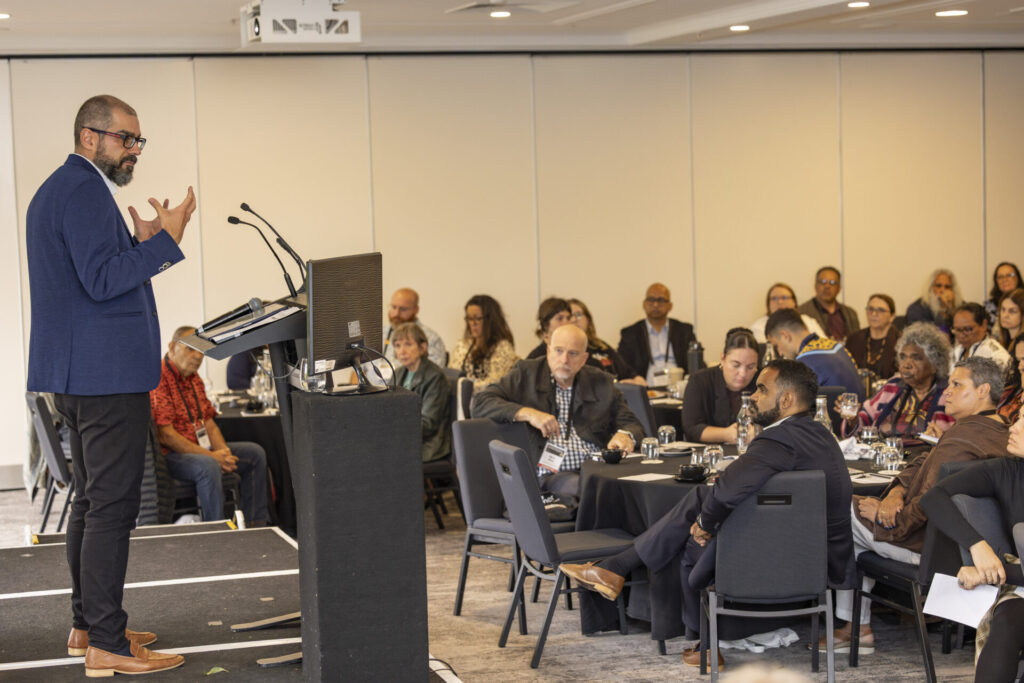
In April, I had the privilege of speaking at the inaugural Blak Loungeroom National Philanthropy Conference, held on Wurundjeri Country in Naarm. It was a gathering shaped by sharing, listening and commitment to imagining a different future for philanthropy in this country.
I shared reflections drawn from my work on the Productivity Commission’s philanthropy inquiry and the perspectives generously shared by First Nations people and organisations during the inquiry. This piece is based on my remarks at the conference.
Thank you to John Harding and the Barmal Bijirril Foundation for creating the space for these important conversations, and for all the work that went into organising this gathering.
Philanthropy and history
I am conscious that Philanthropy Australia’s role goes beyond supporting growth in giving. We also have a responsibility to influence the shape and direction of philanthropy itself, because how philanthropy is practised matters just as much as how much is given.
That responsibility includes promoting approaches that support self-determination for First Nations people, which is a clear priority within Philanthropy Australia’s Strategy 2033 and central to how we understand our role within the philanthropic ecosystem in Australia.
To understand the present shape of philanthropy in his country, particularly in its structured forms, we need to look at history.
Philanthropy is deeply connected to the distribution of wealth in our society, which has been shaped over time by a range of government decisions and policies. We commonly think of tax incentives and availability of structured vehicles such as giving funds as the main ways in which governments influence philanthropy.
But the landscape of philanthropy in Australia has also been influenced by other historical decisions and choices of governments, including those associated with colonisation and the taking of land which was never ceded.
This broader context mattered greatly during the Productivity Commission’s philanthropy inquiry, which culminated in the Future Foundations for Giving report that was provided to the Australian Government in May 2024. I was honoured to serve as an Associate Commissioner jointly leading the inquiry.
Listening to First Nations perspectives on philanthropy
Throughout the inquiry, we sought to centre First Nations voices and perspectives. We appreciated the generosity of the many First Nations people and organisations who shared their stories and experiences, and were thankful for the guidance of the Commission’s then Indigenous Commissioner, Romlie Mokak, and Indigenous staff within the Commission.
Two themes emerged consistently. Firstly, that government policy has a profound impact on philanthropy, as I touched on earlier. Secondly, and critically, how philanthropy is practised matters.
Many First Nations organisations want to engage more deeply with philanthropy, but prevailing funding practices often create significant barriers to this. There is often a power imbalance between large donors and organisations seeking funding, and the negative effects of this imbalance are not always recognised by funders.
We heard evidence that some First Nations organisations choose not to apply for philanthropic funding at all because the conditions attached would require them to compromise their autonomy, values or ways of working.
We also heard examples of impersonal funding practices, onerous reporting requirements and complex application processes that are simply too burdensome for small, community-controlled organisations to navigate.
These experiences matter because we know that First Nations community-controlled organisations deliver better outcomes, yet they remain significantly underrepresented in the distribution of philanthropic funding.
Traditions of generosity, altruism, community and reciprocity have been practiced by First Nations peoples in these lands for tens of thousands of years, before the concept of ‘philanthropy’ had even developed in Europe, let alone arrived in what is now Australia.
We recognised the ongoing strength and resilience of these proud traditions, expressed in new and diverse forms. First Nations-led funds. Intermediary organisations that invest in trust and relationship building. Partnerships grounded in reciprocity rather than control. Approaches involving a genuine transfer of power and decision-making authority. In so many ways, First Nations leadership is changing the landscape of philanthropy in Australia.
Examples include the Maranguka initiative, a First Nations-led justice reinvestment approach in Bourke; First Nations Futures, which supports long term and unrestricted funding and amplifies First Nations voices within philanthropy; and Koondee Woonga gat Toor rong, a First Nations led philanthropic fund whose name in Woiwurrung language means “to give jointly, to share together”.
Acting on what is heard
The inquiry concluded that philanthropic sector more broadly still needs to evolve its approaches, with a mindset of “what do we need to do differently?”. And it needs to listen to what is heard.
Too often we hear the right words about supporting self-determination and First Nations leadership within philanthropy. But then when the time comes to transfer real power, that is when hesitation emerges.
But responsibility for change does not rest with the philanthropic sector alone. The inquiry drew a clear line between historic government policy, the distribution of wealth, and the dynamics of philanthropic power in contemporary Australia. If government choices in the past contributed to inequities, then government choices today can also help to change these inequities.
The inquiry recommended that the Australian Government support a new independent First Nations-led entity, provisionally called “Indigenous Philanthropy Connections”. Its purpose would be to build culturally safe and respectful philanthropic funding practices, support relationships between First Nations organisations and philanthropic networks, and contribute to the growth of First Nations-led philanthropic initiatives across the country.
The inquiry also concluded that Australia’s deductible gift recipient (DGR) system is not fit for purpose and needs reform. It has evolved in an ad hoc and piecemeal way, failing to reflect the realities of many First Nations organisations.
The decisions of governments reflect our values and priorities as a nation and a community. Our current DGR system excludes certain First Nations organisations, such as Reconciliation bodies, and burdens many others with red tape. By not acting to reform a system that leads to such unacceptable outcomes, what statement is being made?
Initiatives such as the Unlock DGR campaign, led by Justice Connect and supported by Philanthropy Australia, signal growing momentum for fixing the broken DGR system. But ultimately, progress will require sustained effort, partnership and leadership.
Where to from here?
More broadly, for those of us working in philanthropy, there is a responsibility to sit with discomfort where it arises, and to question our own assumptions.
Building the future foundations for First Nations philanthropy does require work. The philanthropic sector needs to step up further, as does government. It also involves change, and that is not always easy. But we do things that may be difficult, because they are the right thing to do.
Main image: The inaugural Blak Loungeroom National Philanthropy Conference was held in Naarm in April 2026. (Photo courtesy of Jillian Mundy)
Strategic priority
Advocate, Amplify, Convene


