
Dr Sonja Hood AM: Belonging is more than a visa category or postcode
 Stacey Knott, Senior Lead, Content & Media, Philanthropy Australia
 Fri, 24 Jul 2026
Estimated reading times: 3 minutes
Fri, 24 Jul 2026
Estimated reading times: 3 minutes
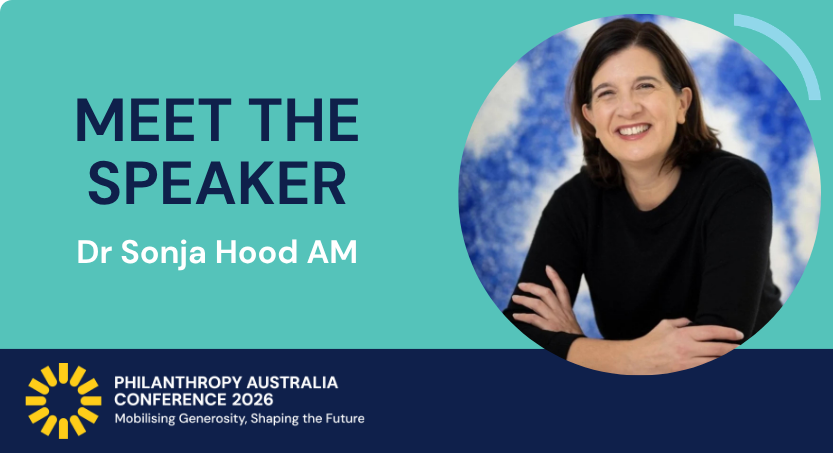
Australia is changing, and so too are the debates about who belongs here.
According to the Scanlon Foundation Research Institute, 32 per cent of Australians – around 8.8 million people – were born overseas. Migration has been the largest driver of population growth since 2006. Compared with 1996, Australia’s migrant population is more diverse than ever, with India and China now among the leading source countries, and the number of temporary visa holders has grown from just under one million in 2000 to around three million today.
For Dr Sonja Hood AM, CEO of the Scanlon Foundation, Australia’s changing migration picture helps explain why immigration remains a source of intense public debate.
“The shape of what Australia looks like has changed significantly over the past 25 years,” she says. “When we talk about who Australians are, we don’t have the same definition that we’ve always had. That has led to this public sense of a lack of control. Control has always been a very strong narrative in Australia’s migration history.”
Founded 25 years ago, the Scanlon Foundation has focused on understanding and strengthening social cohesion. Sonja says that diversity is no longer confined to major cities, with communities across regional Australia becoming increasingly multicultural.
“The complexity of who is here has changed,” Sonja says. “We have significantly greater diversity in cultures, backgrounds, life experiences and pathways into Australia. Belonging really underpins social cohesion. It’s more than a visa category and it’s more than a postcode.”
Supporting social cohesion
While the Scanlon Foundation supports national initiatives, much of its work focuses on strengthening belonging at a local level through programs such as Community Hubs Australia, Welcoming Australia and the recently launched Scanlon Community.
“We know a lot of the belonging opportunities are driven by local communities for local communities. And we’re trying to help increase the capacity and rates of that sector.”
The Foundation’s grantmaking reflects that philosophy, supporting projects ranging from Pasifika-led rehabilitation programs in western Sydney and anti-racism education initiatives, to entrepreneurship pathways for young people from regional, multicultural and low-income communities.
One of Sonja’s favourite initiatives is the African Australian Creative Media Grants program. Originally established by the Foundation and now led by the Ubuntu Project, the program supports African Australian creatives while building skills and leadership within the community.
“There’s been this really lovely double impact,” Sonja says. “Not just providing grants to people, but building the capability of organisations to run programs, assess grants and create opportunities that otherwise might not exist.”
Outside of her work with the Scanlon Foundation, Sonja is also President of the North Melbourne Football Club, it’s a club that has also underpinned her sense of belonging.
“I’ve been a club member since I was a kid. Footy was a very important part of my growing up. It underpinned my sense of belonging in my community. I went with my dad – I take my kids now. It’s a family connection piece for me, and I think for new Australians, it’s often a really easy way in.”
Speaking at Conference 2026
Sonja will bring these themes of belonging, migration and social cohesion to Philanthropy Australia’s Conference 2026. She will join Paul Ash, CEO of Christchurch Call, and Tim Dixon, co-founder of More in Common, for the panel Divided Times: Rebuilding Trust in an Age of Polarisation, moderated by Welcoming Australia’s Aleem Ali.
She will advocate that despite the challenges, people should feel optimistic that society is more resilient than headlines might suggest.
For Sonja, philanthropy has a unique role to play. Collaboration, she believes, is one of the sector’s greatest strengths and an antidote to polarisation.
“The only thing that’s going to subvert the algorithm is us,” she says. “It’s backing in good people with good ideas, seeding community leaders and supporting strong initiatives.”
“The group that Philanthropy Australia has brought together for the Conference panel is a really good case in point. There are good voices on that stage and there’ll be good voices in the room listening,“ she says.
“This is an Australia conversation. It’s not an immigration conversation. It’s not a haves and haves nots conversation either. It’s an Australia conversation and Philanthropy Australia feels to me to be absolutely the appropriate place to be having it as a conversation.”
Sonja Hood AM is the CEO of the Scanlon Foundation, is also on the Institute of Community Directors Australia Council and is the President of North Melbourne Football Club. She will be speaking at the Philanthropy Australia Conference 2026. Tickets are already 85% sold, so register now.
Strategic priority
Advocate, Amplify, Convene


