
Philanthropy Australia’s advocacy work gains momentum in 2026
 Fri, 7 Aug 2026
Estimated reading times: 3 minutes
Fri, 7 Aug 2026
Estimated reading times: 3 minutes

From tax and Deducible Gift Recipient (DGR) reform, to growing arts philanthropy, to Giving Funds reform, Philanthropy Australia’s advocacy efforts in 2026 have focused on building a stronger enabling environment for philanthropy and civil society.
A key strategic shift for Philanthropy Australia (PA) throughout 2026 has been a stronger focus on advancing policy outcomes that enable philanthropy to support civil society more effectively, recognising that a vibrant culture of giving plays a key role cultivating civic and community life in Australia.
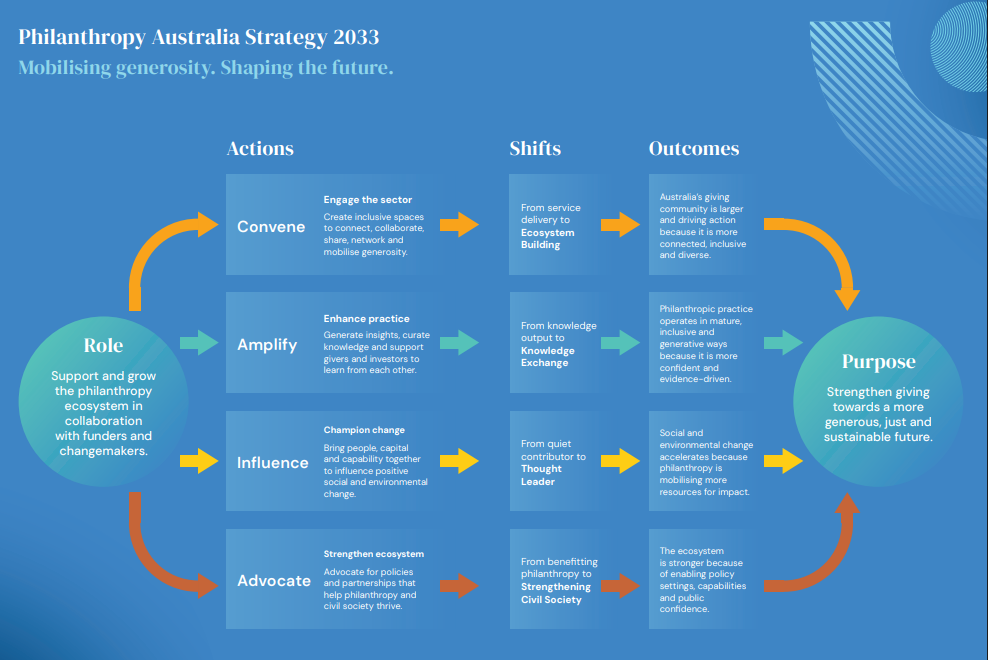
That ambition sits at the heart of Philanthropy Australia’s Strategy 2033, launched in February. The strategy’s Advocate pillar works to strengthen the ecosystem by supporting policies and partnerships that help philanthropy and civil society thrive.
PA’s Executive Director Policy & Sector Development Krystian Seibert, recently hosted a Policy Advocacy Update webinar attended by more than 170 members, sharing key developments and advocacy activities from the first half of the year.
Krystian was joined by Justice Connect CEO Chris Povey and Unlock DGR Campaign Manager Clare Ozich, who spoke about the Unlock DGR campaign, which Justice Connect is leading and PA strongly supports. The campaign seeks to modernise Australia’s DGR framework and remove barriers that currently prevent many charities from accessing tax-deductible giving, helping create a more equitable and effective system.
Tax reform advocacy
More recently, on 31 July, PA lodged a submission to Treasury’s consultation on the proposed introduction of a minimum tax on discretionary trusts.
The submission emphasised that reform of Australia’s DGR system is an important part of ensuring the proposed tax changes do not negatively impact charitable giving. It recommended that distributions to DGR-endorsed charities are deductible for the purposes of the minimum tax. This would ensure charitable giving through discretionary trusts is treated consistently with donations made by individual taxpayers.
However, PA argues that this approach alone is not enough. The Productivity Commission’s 2024 Future Foundations for Giving report concluded that the current DGR framework is no longer fit for purpose. The solution to the issues raised by the proposed minimum tax on discretionary trusts shouldn’t entrench a deficient DGR system, which is why the Australian Government must prioritise a wider overhaul.
This view was also reflected in other submissions, including from Justice Connect and the Community Council for Australia, and was highlighted in the Australian Financial Review. In the article, Philanthropy Australia Chief Executive Maree Sidey said:
“By implementing DGR system reform, more charities would be eligible to receive tax-deductible donations, whether they are from an individual taxpayer or from a discretionary trust.”
Other advocacy highlights
Other advocacy highlights so far this year include the following.
- In April, PA made a submission to an Australian Parliament committee inquiry into arts and cultural philanthropy. Krystian appeared before a public hearing for the inquiry, discussing PA’s recommendations and topics such as intergenerational wealth transfer and the role of advisers
- In June, PA played a key role in securing amendments to proposed capital gains tax changes announced in the Federal Budget that could have had unintended consequences for philanthropic giving. Working with members and partners, PA advocated for changes that maintained important incentives for giving, while acknowledging the complex nature of tax reform and the need for governments to balance various policy objectives. Other highlights include the following
- Also in June, PA also made a submission to the Royal Commission on Antisemitism and Social Cohesion, supporting the Australian Jewish Funders’ submission and focusing on the experience of Jewish people within the philanthropic sector
- In July PA supported discussions about growing First Nations philanthropy in Australia, with Maree and Krystian attending a Strengthening the First Nations Philanthropic Ecosystem Roundtable, hosted by Assistant Minister for Charities, The Hon Dr Andrew Leigh MP, at Parliament House
- Also in July, Krystian was appointed to the Australian Charities and Not-for-profits Commission (ACNC) Advisory Board, recognising his expertise in shaping policy and regulatory frameworks for philanthropy and the not-for-profit sector.
Ongoing consultation on Giving Funds reforms
In February, the Australian Government announced proposed reforms to Public and Private Ancillary Funds, which will be renamed Giving Funds.
The proposed changes include increasing minimum annual distribution requirements from 4 per cent to 6 per cent for Public Ancillary Funds and from 5 per cent to 6 per cent for Private Ancillary Funds, alongside greater flexibility to smooth distributions across multiple years.
Philanthropy Australia responded to this announcement, noting that the changes will not take effect for some time and that transitional arrangements are proposed for existing Giving Funds. Consultation on draft amendments is expected later this year, and members will be kept updated on developments.
As advocacy work continues throughout 2026, PA will remain focused on advancing Strategy 2033 by creating the policy conditions that enable philanthropy and civil society to thrive, working with members and partners as part of these efforts.
Strategic priority
Advocate
Subject
Government, Policy and advocacy


