
Amplifying diverse voices: what philanthropy can learn from the Economic Media Centre
 Stacey Knott, Senior Lead, Content & Media, Philanthropy Australia
 Fri, 16 Oct 2026
Estimated reading times: 2 minutes
Fri, 16 Oct 2026
Estimated reading times: 2 minutes

Six years ago, the Economic Media Centre (EMC) set out to change who gets to shape Australia’s economic conversations.
Since launching in 2020, Australian Progress’ EMC has supported more than 1,200 spokespeople at small, unwaged or low-budget organisations that often lack dedicated communications capacity. In that time, it has helped place an average of 600 stories in the media each year on issues ranging from renting and social security to policing, all with an ambition of driving social transformation.

For EMC director Alex Kelly, the goal is simple.
“If you have more diverse voices, especially from impacted communities, in public conversations, you can reshape policy. We know that people with lived experience can speak with the greatest complexity and understanding and analysis of their situation.”
Alongside connecting journalists with its list of spokespeople, the EMC provides free training in writing opinion pieces, campaign messaging and interview preparation, helping people with lived experience speak not only about problems but also solutions.
“We know that if policy was co-designed with impacted communities, we’d see much more efficient, much more powerful and much more impactful policies. So that’s really our point of intervention,” Alex says.
With a close eye on the news cycle and strong media relationships, the EMC places between eight and 15 stories a week, across community and legacy media outlets.
“We might get someone on 3AW, we might have someone on the front page of The Age, we might have someone on Late Night Live on Radio National.”
Authentic voices
The EMC’s approach is built on authenticity and ensuring people speak in their own voice.
“We can hear when someone’s a publicist or they’re speaking from talking points. When you hear someone that’s talking in their own vernacular, with their own accent, with their own humour, it actually cuts through in a really powerful way,” Alex says.
One organisation that has grown alongside the EMC is the Antipoverty Centre. Co-founders and co-coordinators Kristin O’Connell and Jay Coonan have built a national profile by centring the expertise of people directly affected by poverty and unemployment.
“The fundamental purpose of our organisation is to make sure that people who are directly affected by poverty, unemployment and welfare policies are positioned as experts and have a leading role in policy development and in the advocacy work,” Kristin explains.
With support from the EMC, the organisation has played a significant role in shifting how poverty is discussed across civil society and policy debates, including in May this year in response to federal government employment services reforms.
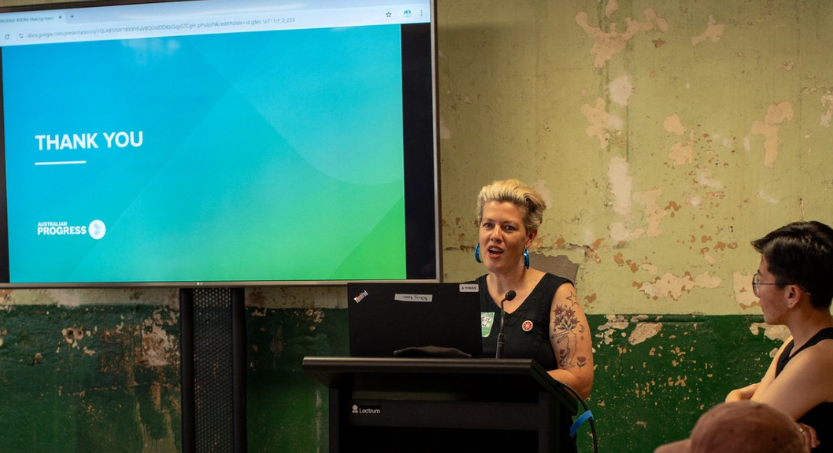
‘Guts and vision’
For philanthropy, there are lessons in how both organisations operate.
Alex says philanthropy has an important role in funding a diverse portfolio of connected organisations that amplify one another’s work, helping build the cumulative narrative needed to shift public opinion and support policy change.
The Antipoverty Centre was built with community support and crowdfunding campaigns. It has been building up relationships with philanthropic organisations that have recently offered long-term support.
Kristin and Jay highlight the value of trust-based philanthropy: flexible funding, low administrative burden and relationships built on mutual learning.
“Money aside, the support from those groups personally has been phenomenal and really helpful to not only furthering the work that we’re doing, but also the work that they’re doing themselves as funders. This is being influenced by the conversations that we’re having and the time that we’re spending together, so that they’re better understanding what it is that we’re fighting for,” Jay explains.
The EMC’s story is also a reminder that strategic philanthropy is not always about scale, but about identifying and backing ideas that fill a gap.
“When we started this project six years ago, it was also a number of individual donors that had the guts and the vision to be those early funders that helped us pilot EMC and get it off the ground,” Alex says.
“We’re a very small, lean outfit, but we make a huge impact. Things don’t have to be enormous and they don’t actually have to be complicated.”

The Economic Media Centre is celebrating its sixth anniversary this month and invites those from the philanthropic sector to an event in Melbourne on Thursday 29 October.
Strategic priority
Amplify, Convene


 News
News
