
From Brisbane to New York: Why belonging is the key to Australia’s generosity
 By Maree Sidey, CEO, Philanthropy Australia
 Fri, 2 Oct 2026
Estimated reading times: 2 minutes
Fri, 2 Oct 2026
Estimated reading times: 2 minutes

What do global debates on trust and cooperation mean for Australian philanthropy? Philanthropy Australia CEO Maree Sidey reflects on lessons from New York during the United Nations General Assembly and Climate Week, and why belonging matters more than ever.
Two weeks after our Philanthropy Australia Conference, I was in New York for my first United Nations General Assembly and Climate Week. While the scale and complexity of these global gatherings can feel worlds away from our own sector discussions, I was struck by how closely many of the themes mirror the conversations we are having here in Australia.
Outgoing Secretary-General António Guterres’ warning that “the fault lines in our world are widening” was particularly stark. He argued that humanity’s future will be shaped by how it responds to four great tests of power: war, inequality, climate change and artificial intelligence.

Regardless of geography, a common thread emerged: how we navigate profound change while ensuring its benefits are shared equitably.
My biggest takeaway from New York was this: the question for philanthropy isn’t whether the world is changing. It’s whether we are willing to change with it.
And for me, that change begins with rethinking how we understand and encourage generosity.
Again and again in New York, discussions returned to trust, cooperation and collective action. These are ultimately questions of relationships: whether people feel connected to one another and invested in shared outcomes.
Our paradox
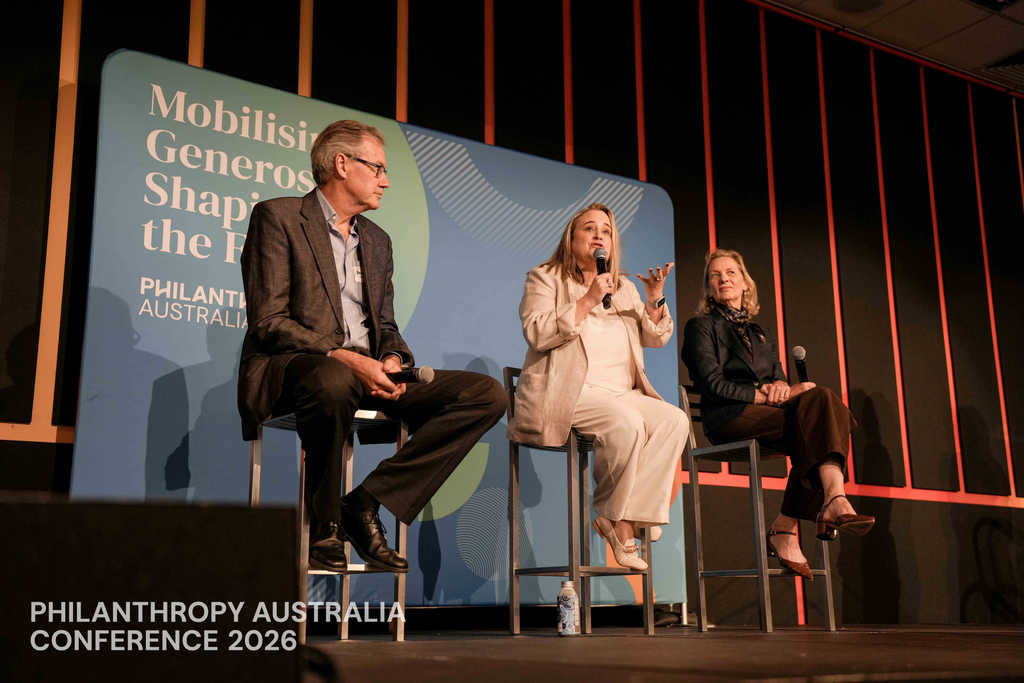
At our September conference in Brisbane, I returned to the question I have wrestled with since stepping into my role two years ago: how do we actually mobilise generosity?
Mobilising generosity is at the heart of our strategy and the national ambition to double giving by 2030. But shared ambition is not the same as knowing how to achieve it.
Australia is one of the world’s wealthiest nations. Hearing global leaders describe the challenges facing their countries, and meeting philanthropic organisations in New York, reinforced how fortunate we are.
Yet we face a paradox.
National participation in giving is still declining. We’re rightly focused on increasing the dollars flowing into charities and causes, but fewer Australians are giving than they once did. At the same time, there are countries with fewer resources that appear to sustain stronger cultures of generosity, volunteering and community participation.
Giving is an action
For much of the past decade, we’ve focused on the mechanics of giving: tax settings, policy reform and fundraising. These create conditions in which generosity can thrive.
But they don’t explain why people choose to give.
Giving is an action. Generosity is a feeling.
And it’s the feeling that leads to the action.
I increasingly wonder whether we’ve treated giving as a transaction rather than something people need to feel part of – focusing on what people give instead of what motivates them.
One insight from the World Giving Report Donor Insights became a genuine lightbulb moment for me which I shared at our conference. Across all income levels, people with a strong sense of belonging are three times more likely to give, volunteer and contribute to their communities.
Belonging is not simply a nice-to-have. It’s fundamental to building a generous society.
And unlike many of the challenges we discuss, belonging is something we can actively cultivate.
We are living through profound technological, geopolitical and social change. Across the United Nations and my meetings in New York, I was repeatedly reminded that organisations and institutions will thrive only if they build trust, connection and resilience.
Cultivate belonging
Philanthropy must adapt to this complex, fast-moving environment. Strategy alone won’t be enough: we need greater collaboration, urgency and commitment to community-led solutions.
No organisation, funder or network can solve the challenges ahead alone. Strengthening generosity means strengthening the networks, intermediaries and institutions that connect people and enable collective action.
Ultimately, the lesson I took from both Brisbane and New York is a simple one.
If we want to mobilise more generosity in Australia, we should spend less time asking how to get people to give and more time asking how to help people belong.
That means investing not only in outcomes, but in the institutions, networks and shared spaces that help people feel connected to one another. When people feel they belong, they are more likely to contribute, participate and care for one another.
And in a world grappling with division, uncertainty and rapid change, building belonging may be one of the most important investments philanthropy can make.
Strategic priority
Amplify, Convene
Subject
Impact investing, Structured giving


 News
News
